House & Office SH
office | residence
Nagoya Aichi, Japan
office | residence(Wooden)
Construction area:40.99㎡
Floor area:68.73㎡
Structural Design : Komatsu Structural Design
Contractor : Hirata Construction Co., Ltd.
Photo : Takashi Uemura
office | residence(Wooden)
Construction area:40.99㎡
Floor area:68.73㎡
Structural Design : Komatsu Structural Design
Contractor : Hirata Construction Co., Ltd.
Photo : Takashi Uemura
Urban Resources
This project is for a new office and residence for a construction company with a 50-year history in Nagoya, Aichi Prefecture. The client owned two large warehouses near the site, both overflowing with unused timber—mostly surplus wood ordered in bulk by the previous generation, who had been a carpenter, along with reclaimed lumber collected during demolition. Although there were no clear plans for its use, the material had continued to accumulate year after year, too valuable to discard. Many construction companies and lumberyards across Japan hold similar stockpiles of timber lying dormant in warehouses. Due to irregular shapes and uncertain species, these large-section pieces are difficult to reuse as structural members, often being cut down only for finishing materials. However, much like extracting rare metals from discarded electronic devices, I wondered whether it might be possible to find new value in such unused urban resources—and in doing so, create a new cycle of material use within the city.
Closed Streetscape
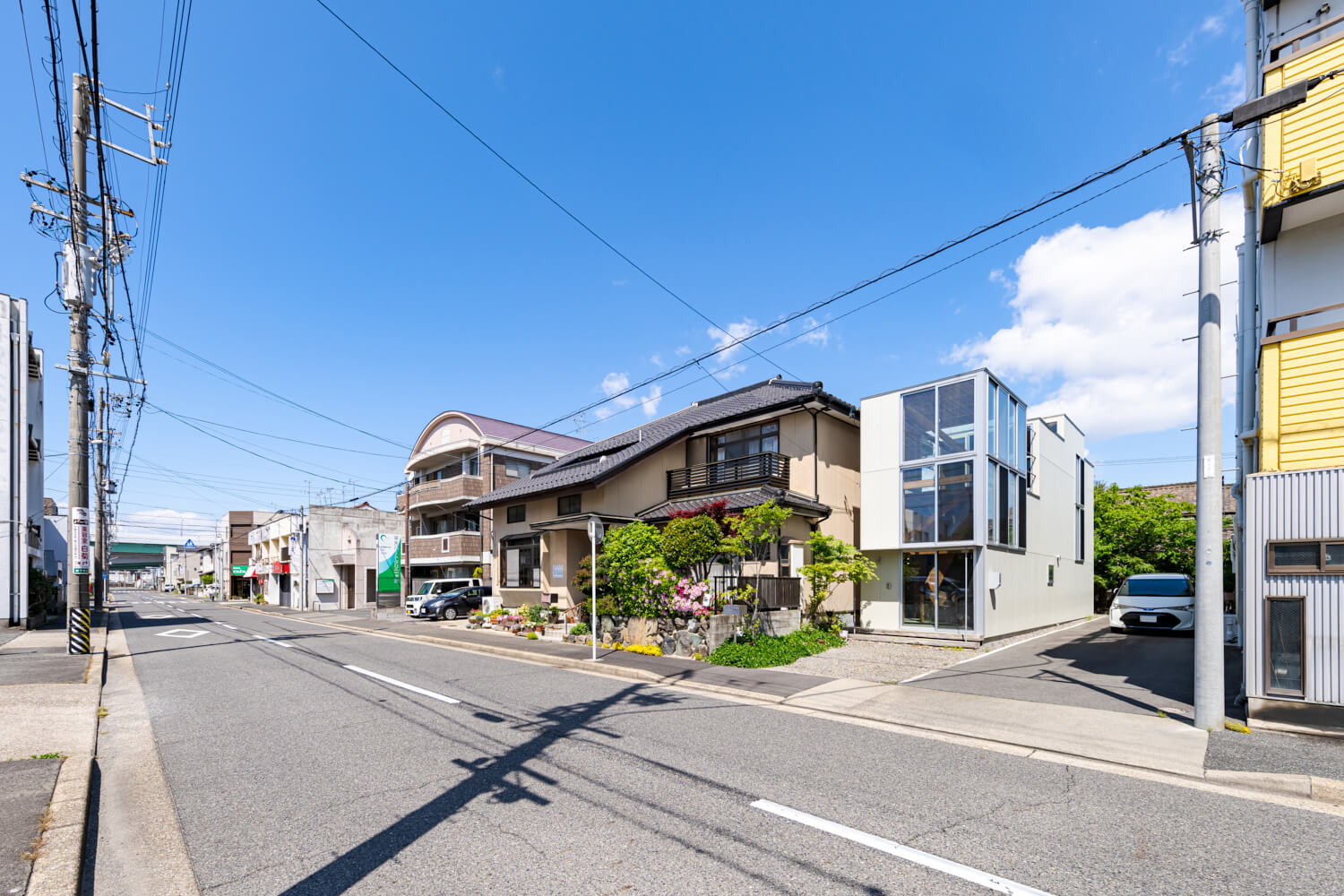
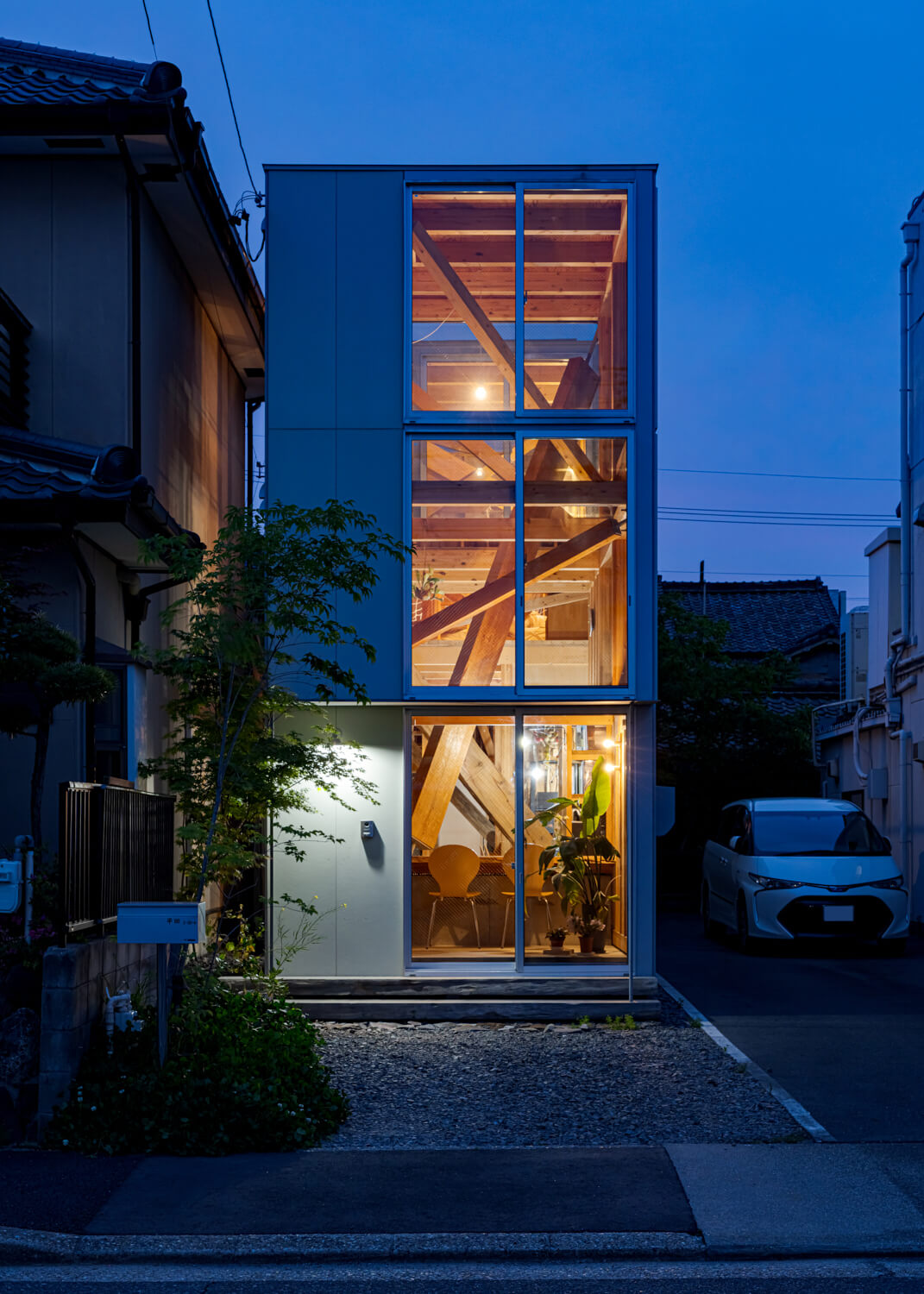
The site is located in a dense, low-rise neighborhood that retains traces of an older urban fabric. Many buildings here traditionally combined commercial or workshop spaces on the ground floor with living quarters above. Yet, with the rise of large shopping malls, many of these small businesses have closed. As a result, even where people still live on the upper floors, the ground level of the streetscape has become lined with shuttered façades. The client’s family, who have lived in the area for many years, felt a deep sense of regret over this decline. As a local construction company engaged in community building, they hoped to create a work of architecture that could serve as a statement toward an “open” streetscape. In typical configurations—where commercial and residential uses are separated vertically (commerce below, residence above) or horizontally (commerce facing the street, residence behind)—once the commercial function ceases, the building’s relationship with the town is effectively severed. This project seeks to dissolve the rigid boundaries between work, commerce, and living spaces within the building, allowing each to connect with the town in different ways while maintaining an adjustable sense of distance.
An Open Structural System Utilizing Stored Timber
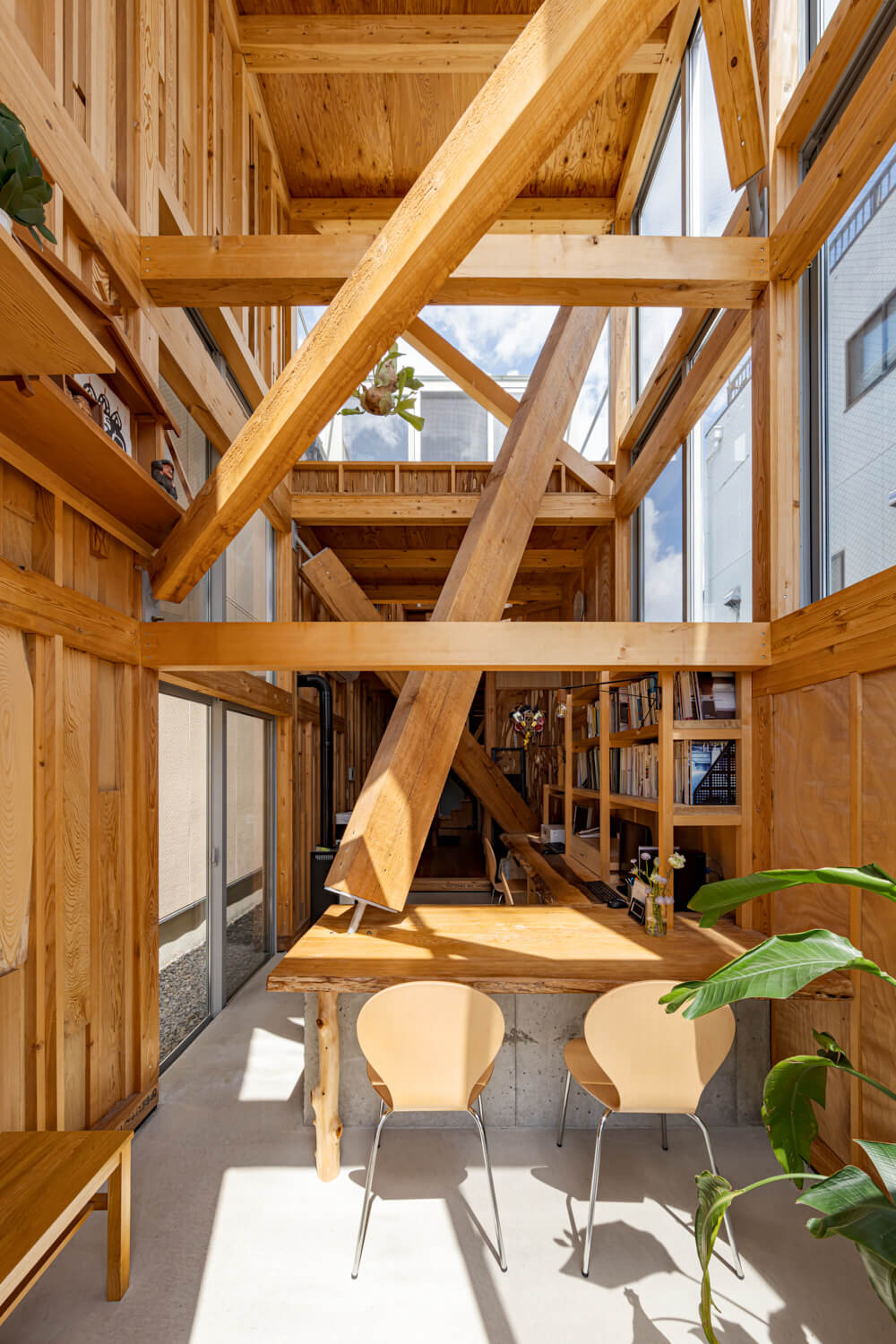
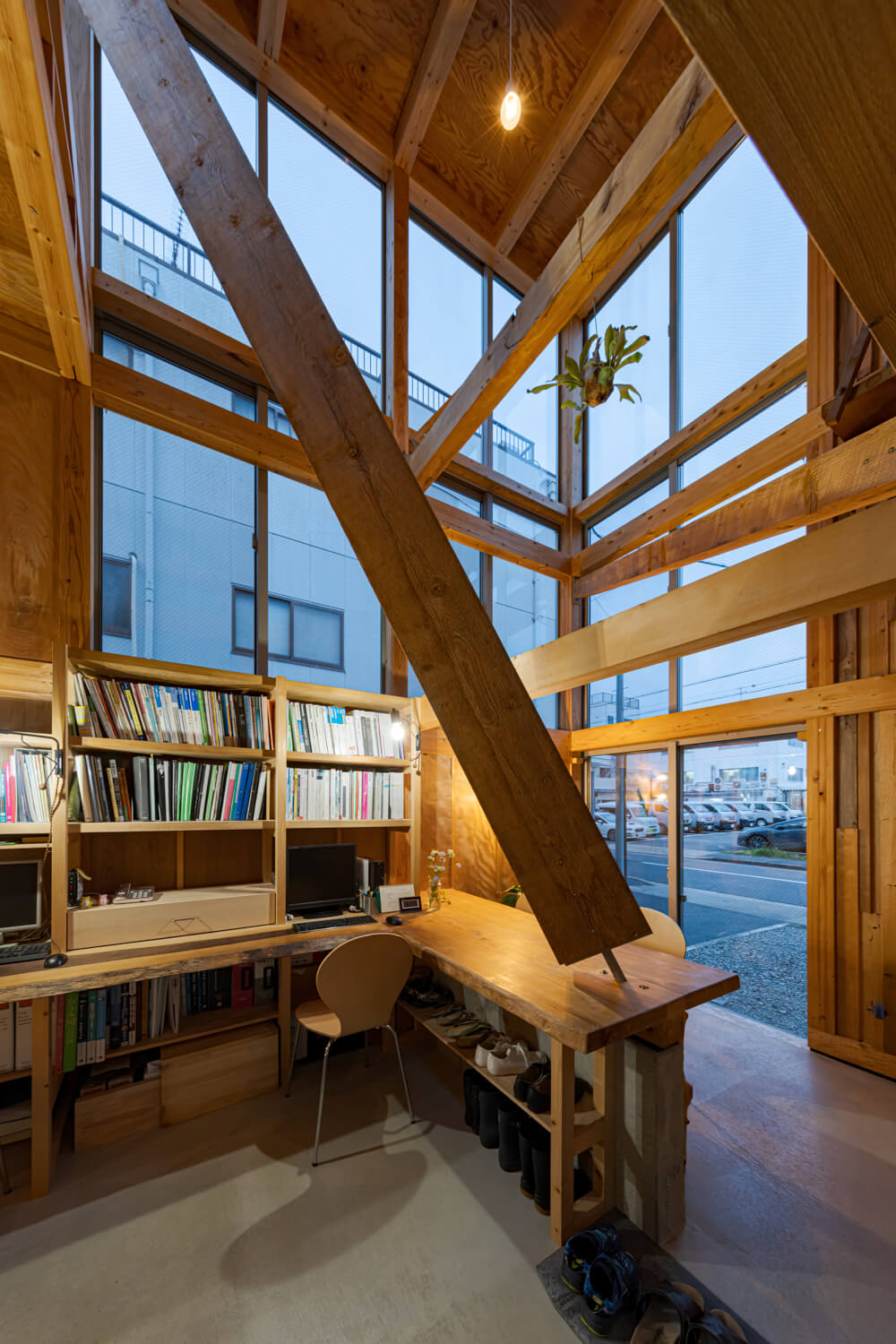
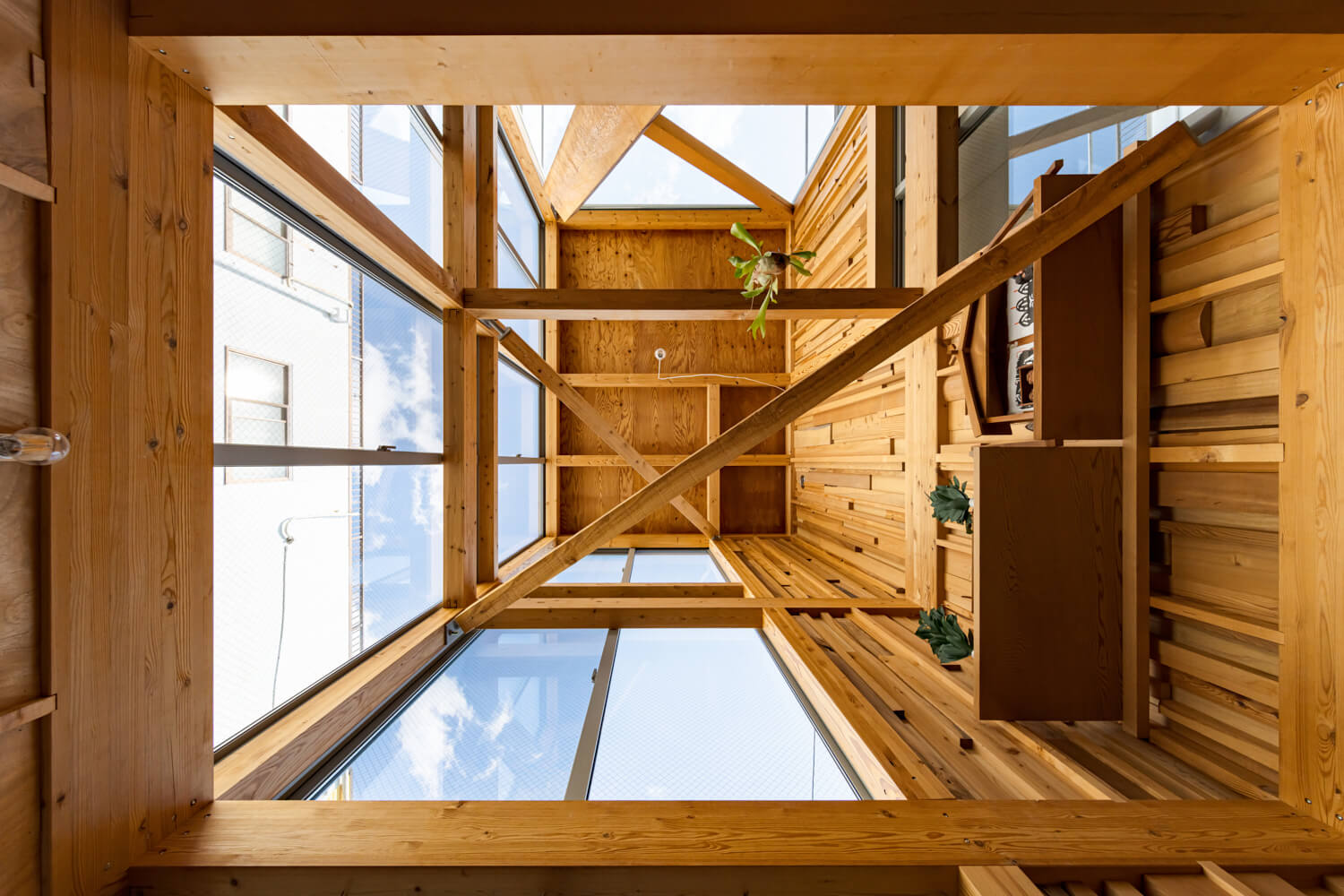
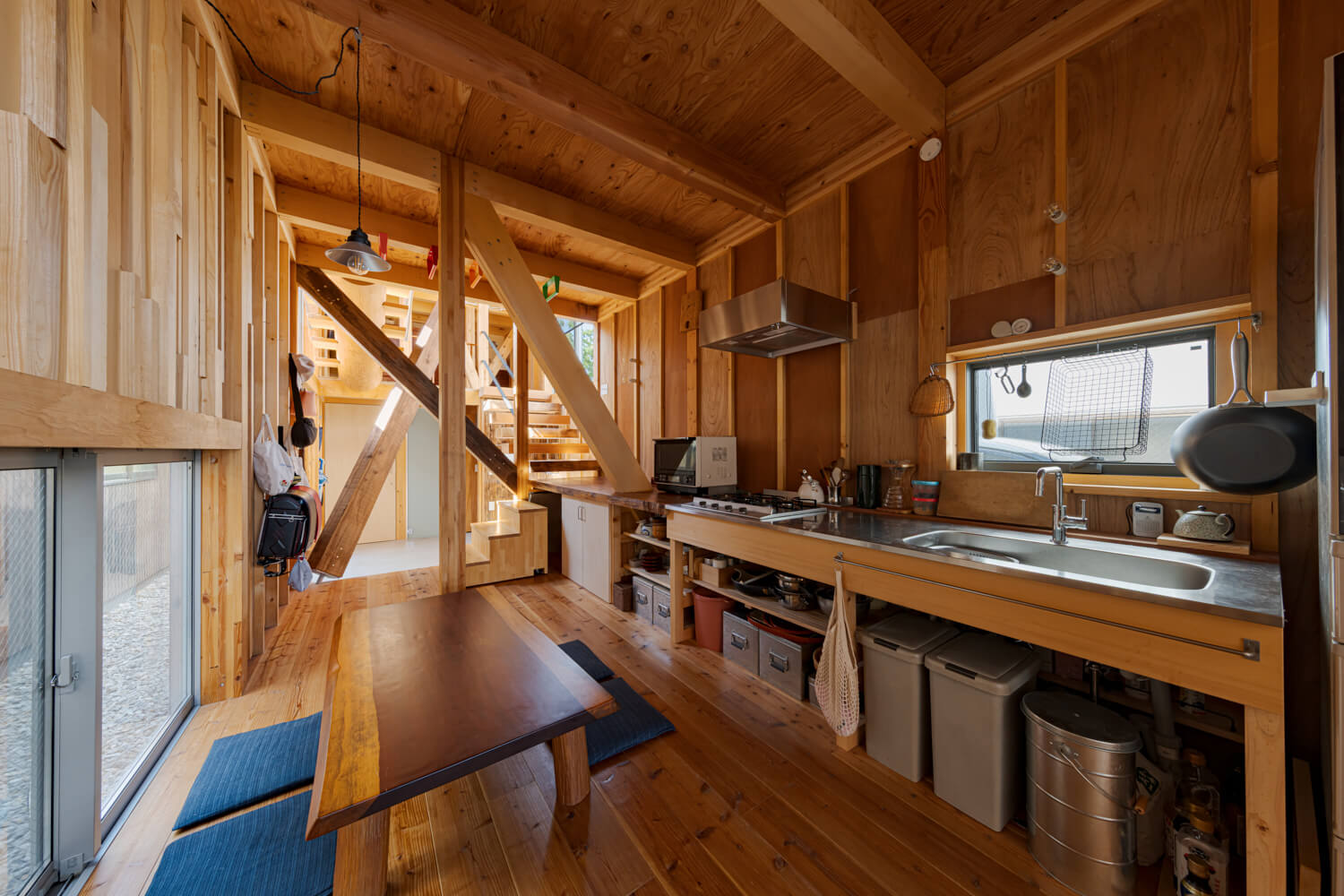
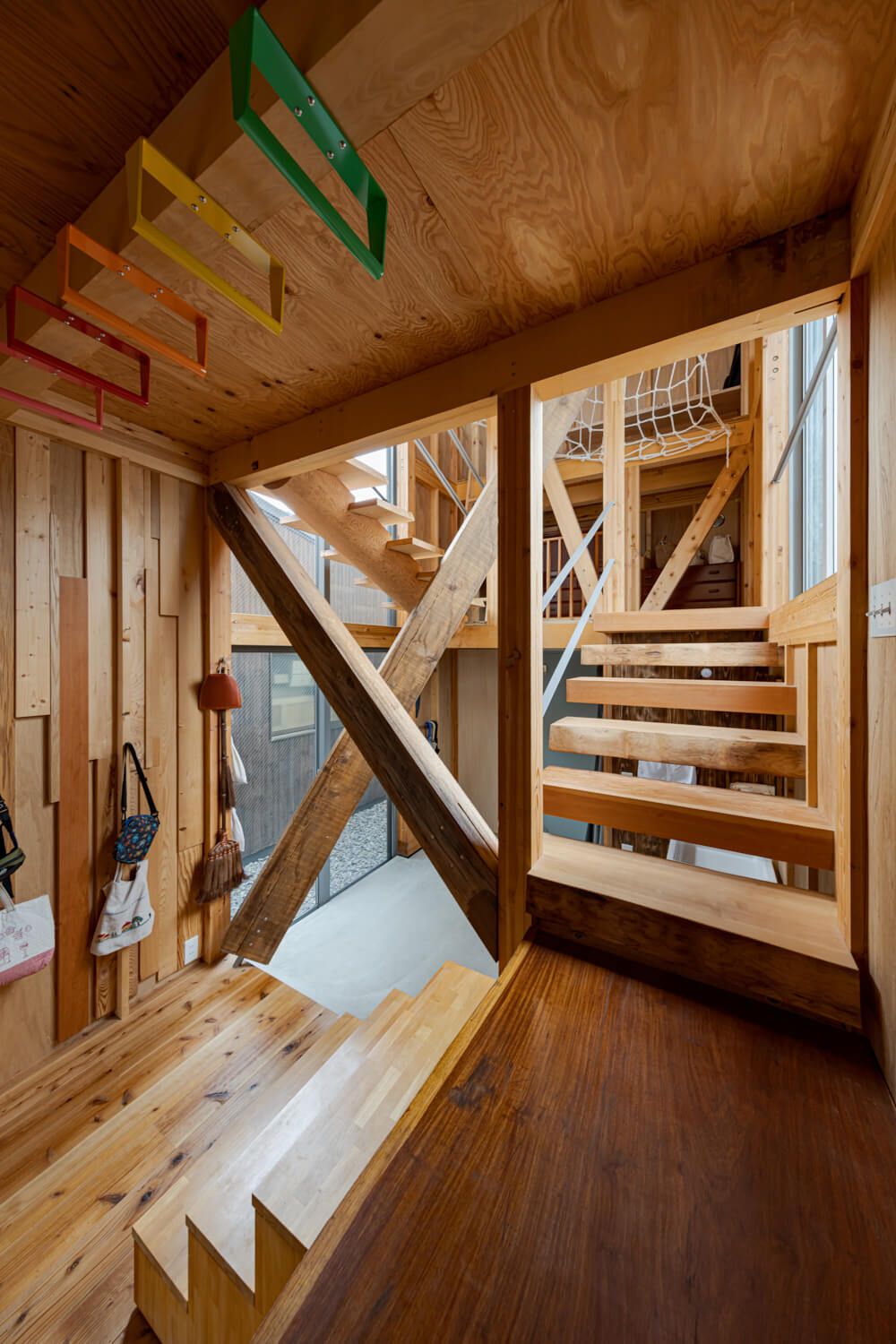
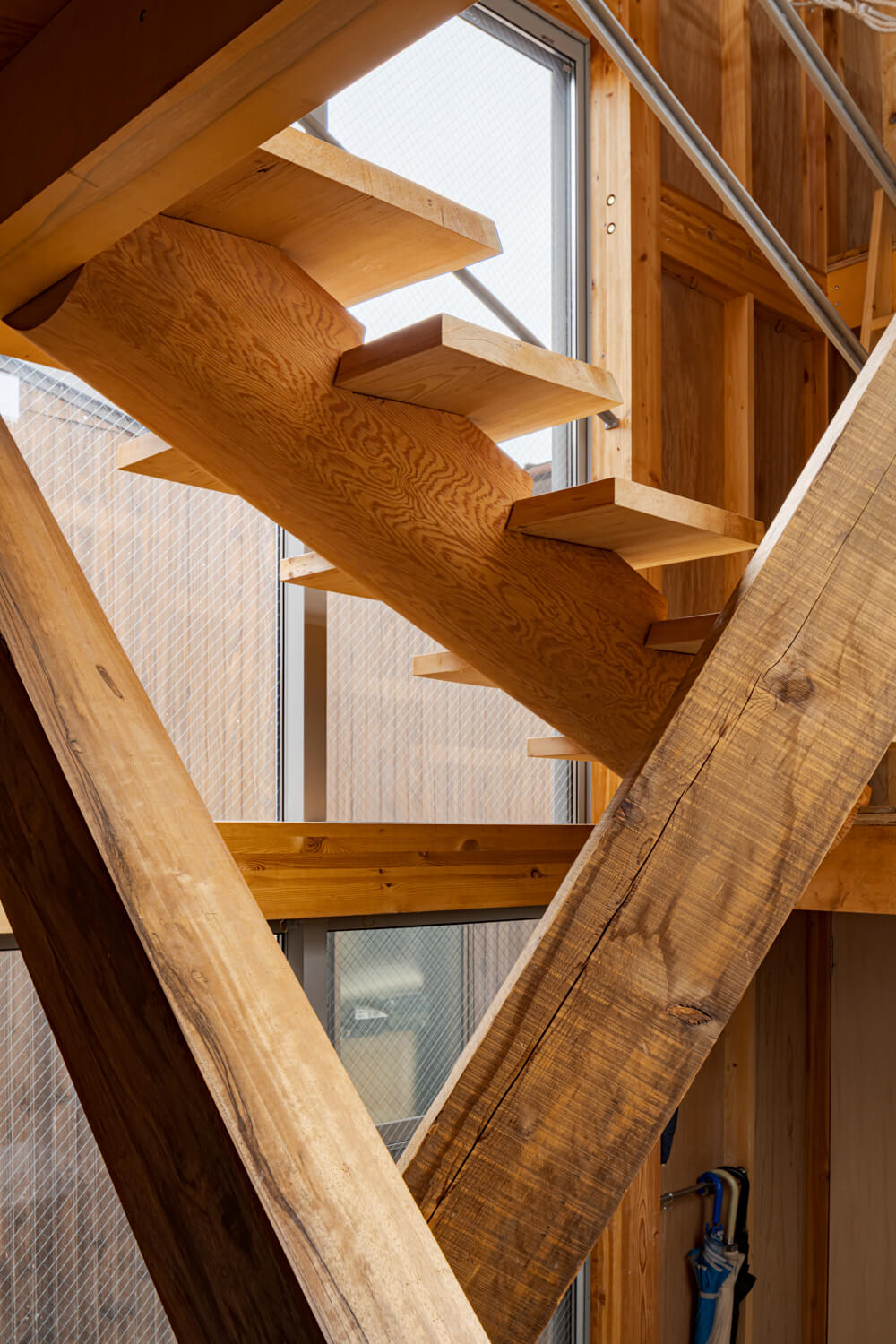
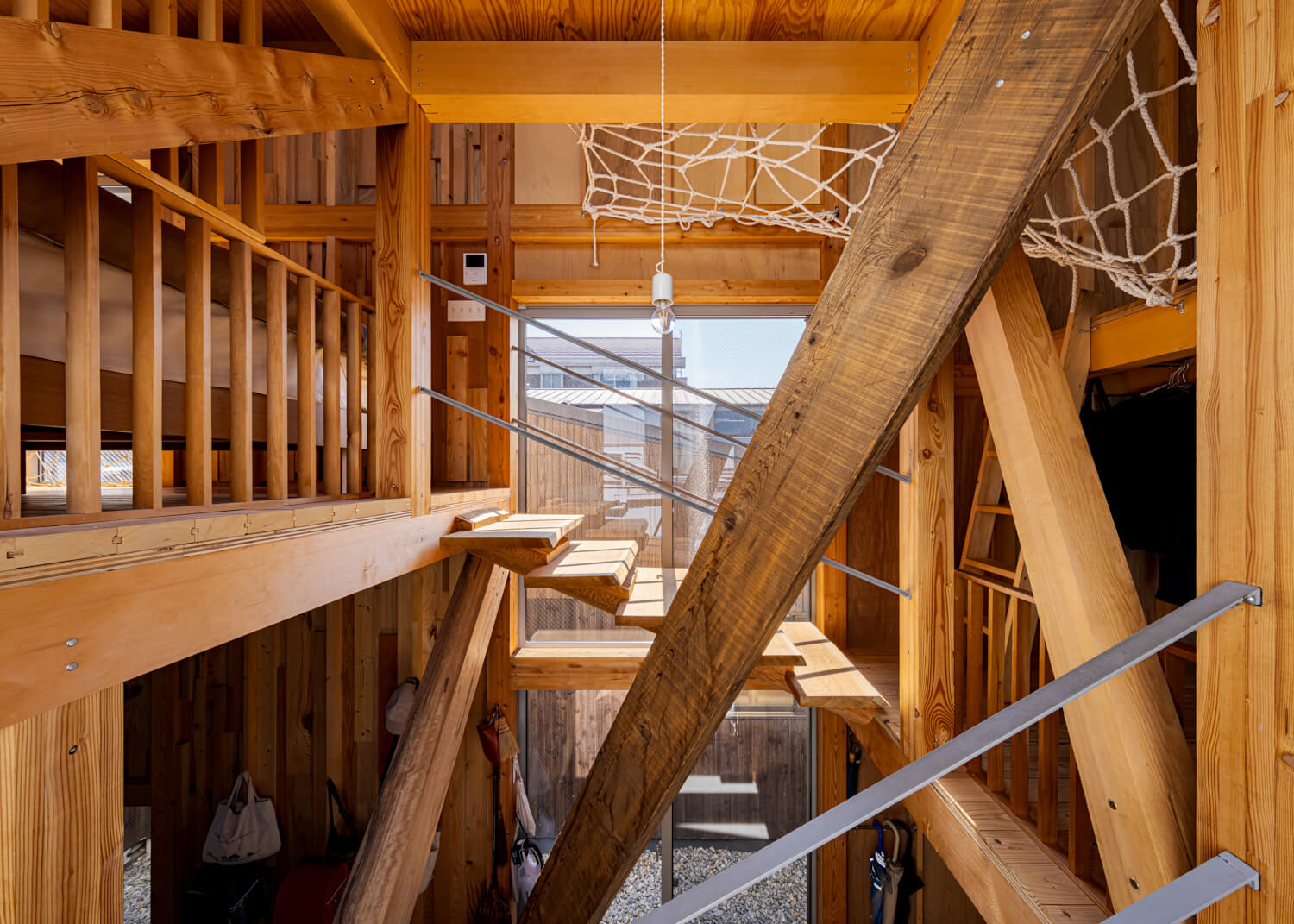
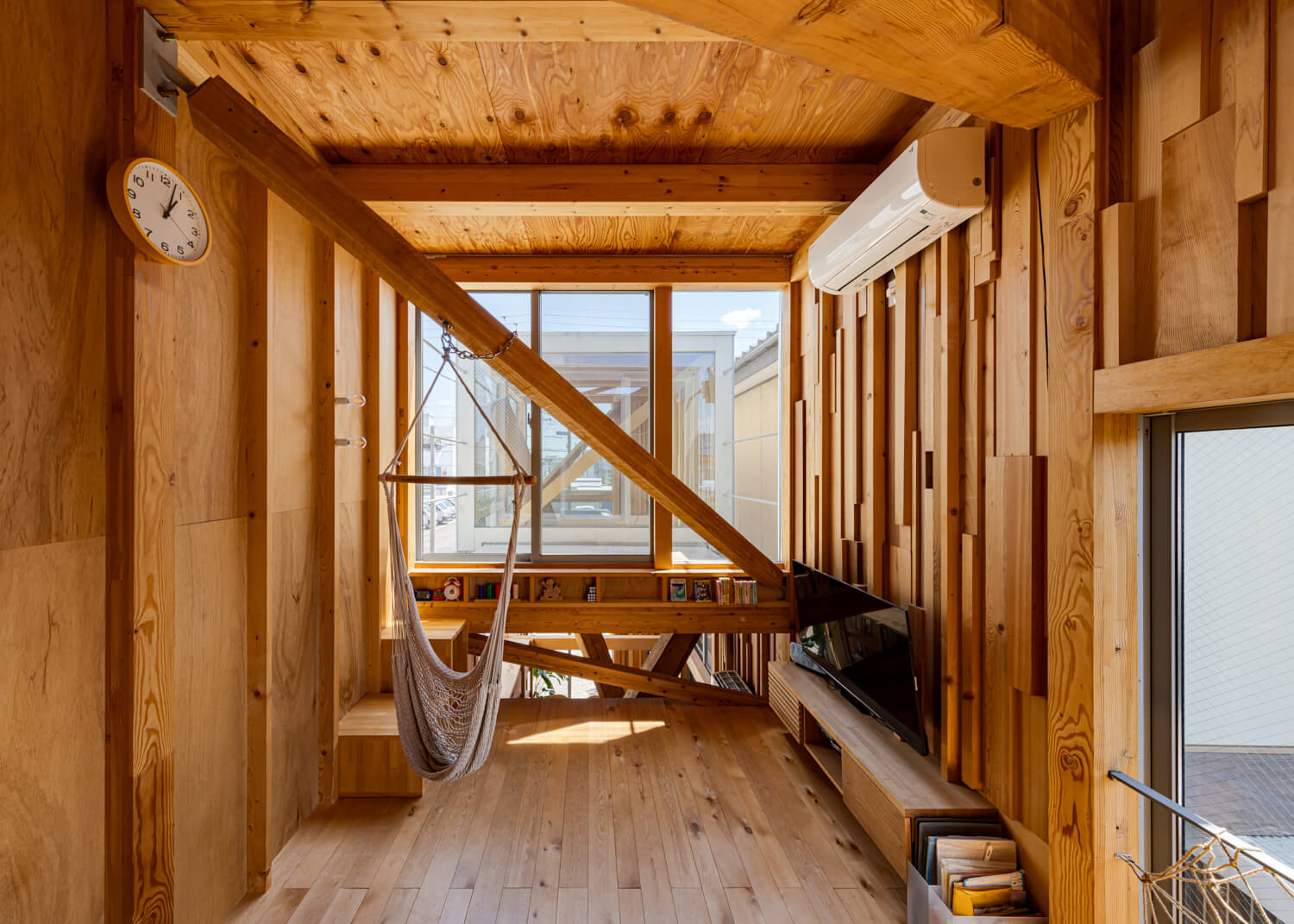
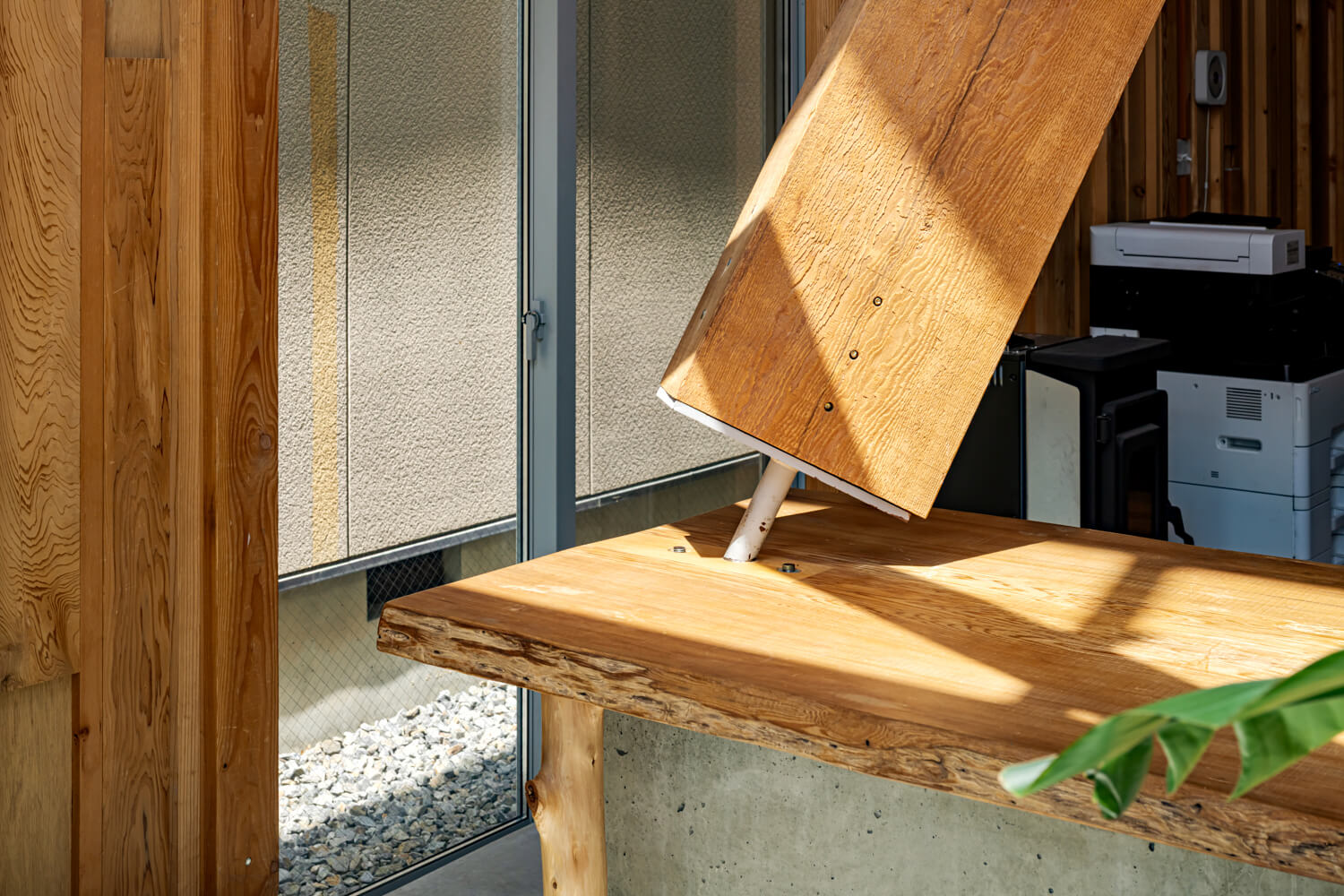
The design proposes both a method for rationally utilizing stockpiled timber and a building form suitable for a neighborhood where commercial, industrial, and residential functions coexist. Specifically, the stored timber was used as diagonal braces, preserving as much as possible of each member’s original length and shape. By achieving the required structural strength through these elements, we minimized opaque shear walls in the short-axis direction, allowing the interior to maintain high transparency from the street while gently defining the boundary between commercial and residential areas. The design process treated the dimensions of the stored timber as fixed parameters, adjusting the floor heights and plan dimensions as variables in response. Because each brace had a unique angle, custom metal fittings were fabricated based on 3D coordinates. To accommodate subtle warping and irregularities inherent in the reused timber, the final adjustments and installations were performed by hand.
This project is for a new office and residence for a construction company with a 50-year history in Nagoya, Aichi Prefecture. The client owned two large warehouses near the site, both overflowing with unused timber—mostly surplus wood ordered in bulk by the previous generation, who had been a carpenter, along with reclaimed lumber collected during demolition. Although there were no clear plans for its use, the material had continued to accumulate year after year, too valuable to discard. Many construction companies and lumberyards across Japan hold similar stockpiles of timber lying dormant in warehouses. Due to irregular shapes and uncertain species, these large-section pieces are difficult to reuse as structural members, often being cut down only for finishing materials. However, much like extracting rare metals from discarded electronic devices, I wondered whether it might be possible to find new value in such unused urban resources—and in doing so, create a new cycle of material use within the city.
Closed Streetscape
The site is located in a dense, low-rise neighborhood that retains traces of an older urban fabric. Many buildings here traditionally combined commercial or workshop spaces on the ground floor with living quarters above. Yet, with the rise of large shopping malls, many of these small businesses have closed. As a result, even where people still live on the upper floors, the ground level of the streetscape has become lined with shuttered façades. The client’s family, who have lived in the area for many years, felt a deep sense of regret over this decline. As a local construction company engaged in community building, they hoped to create a work of architecture that could serve as a statement toward an “open” streetscape. In typical configurations—where commercial and residential uses are separated vertically (commerce below, residence above) or horizontally (commerce facing the street, residence behind)—once the commercial function ceases, the building’s relationship with the town is effectively severed. This project seeks to dissolve the rigid boundaries between work, commerce, and living spaces within the building, allowing each to connect with the town in different ways while maintaining an adjustable sense of distance.
An Open Structural System Utilizing Stored Timber
The design proposes both a method for rationally utilizing stockpiled timber and a building form suitable for a neighborhood where commercial, industrial, and residential functions coexist. Specifically, the stored timber was used as diagonal braces, preserving as much as possible of each member’s original length and shape. By achieving the required structural strength through these elements, we minimized opaque shear walls in the short-axis direction, allowing the interior to maintain high transparency from the street while gently defining the boundary between commercial and residential areas. The design process treated the dimensions of the stored timber as fixed parameters, adjusting the floor heights and plan dimensions as variables in response. Because each brace had a unique angle, custom metal fittings were fabricated based on 3D coordinates. To accommodate subtle warping and irregularities inherent in the reused timber, the final adjustments and installations were performed by hand.